
Science
Dark matter & small scales
Diffraction is sensitive to structure on scales that are dark but pristine, where baryons are neither a contaminant nor a window, which makes coherent sources an excellent probe of dark matter.
Accessing dark and pristine scales
The cosmological abundance of dark matter is known to sub-per-cent accuracy, but its distribution is only directly observed down to sub-galactic scales. Below about 106 M☉ halos go dark: their gravitational potentials are too shallow to hold enough baryons to form stars. That is a curse and a blessing at once: it makes light dark-matter halos a pristine testbed of dark-matter properties, insensitive to the complicated astrophysics that shapes larger structures.
Small scales are also where dark-matter scenarios are most easily told apart. Theories are selected to explain observations on large scales, and that leaves them considerable freedom below the size of a galaxy, where their predictions diverge: some suppressing small-scale structure (ultra-light and warm dark matter), others enhancing it (self-interacting particles, or primordial black holes[1] ). New probes of dark halos therefore have great potential to advance fundamental physics.[2]
Beyond the nature of dark matter itself, diffraction gives access to the initial conditions of the very early Universe. Many scenarios for the formation of cosmic structure (within the inflationary paradigm, for instance) predict an enhancement of the primordial fluctuations, which would leave small-scale halos denser and more abundant.[3] Any observation in that regime is a look into the Universe's earliest moments.
Coherent waves as microscopes
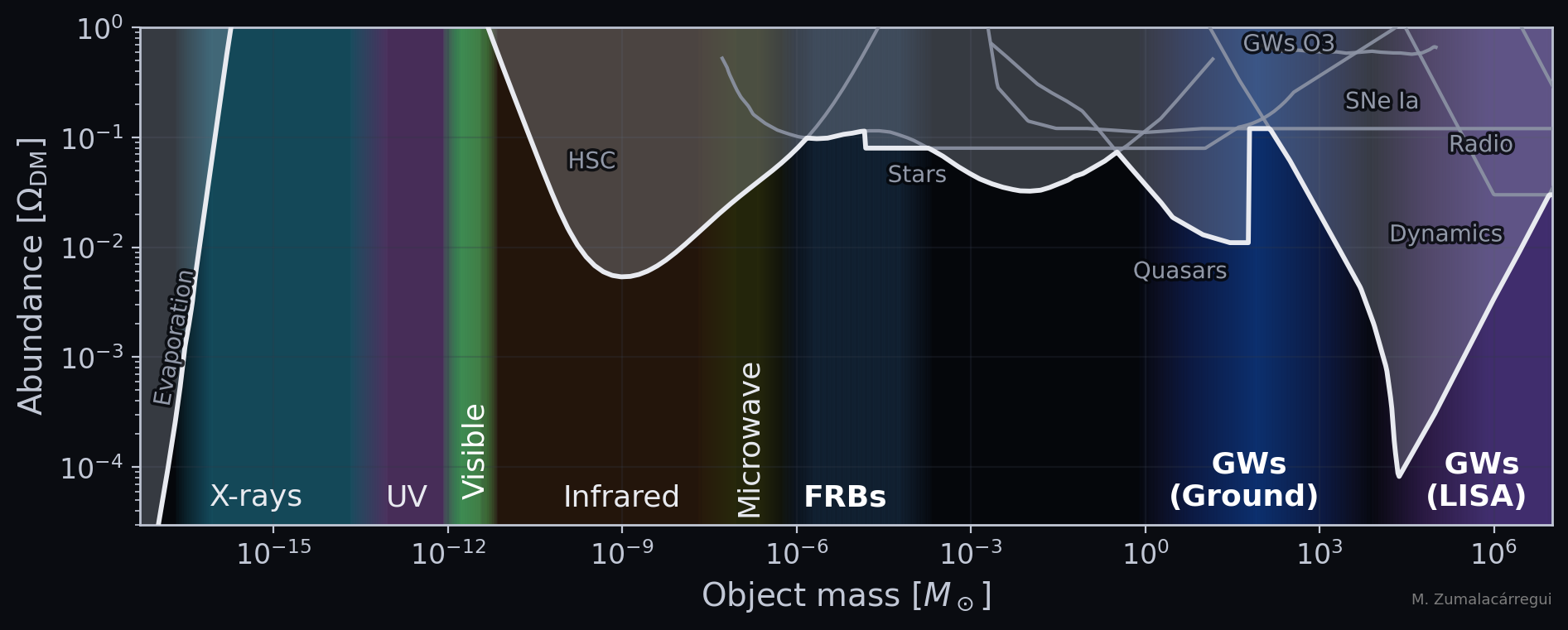
The sensitivity of diffraction is set by the wavelength of the coherent source, and each band reaches a different mass. Ground-based gravitational-wave detectors probe stellar- to intermediate-mass objects. Space-borne detectors are ideal for sub-galactic halos. At the longest wavelengths, the nanohertz waves seen by pulsar-timing arrays raise the possibility of “microlensing by galaxies”.[4] Radio sources are sensitive to planetary masses, with the potential not only to probe dark matter but to find extragalactic planets. At optical frequencies and above, wave optics becomes essential for asteroid-mass objects: a window in which all of the dark matter could still be compact objects.
What makes diffraction a distinctive probe is the richness of its signal. Because the source's frequency is measured, a diffraction pattern carries an unambiguous imprint of the lens's mass scale. It is also sensitive to how that mass is distributed, so observations can distinguish dark-matter profiles: the presence of a core in a halo,[5] or substructure within an object.[6] Some of those properties map directly onto theories: self-interacting dark matter predicts cores whose density is set by the interaction cross-section.[7] A coherent source can characterize an individual halo, much as a diffraction pattern characterizes a single slit, the figure at the top of this page.
A population, not one lens
A different regime emerges when halos are treated collectively, as microlensing treats populations of stars. The result is stochastic diffraction:[8] amplitude and phase fluctuations imprinted on every gravitational-wave event, whose statistical properties encode the properties of the halo population. Those fluctuations can be captured by an effective description and separated from the parameters of the source, which would let LISA[9] probe halos between 10 and 104 M☉, far below the mass of any individually detectable object, as forecast by Choi, Urrutia & Zumalacárregui.
Stochastic diffraction is present in every gravitational-wave signal. That is the sense in which the Universe has a dark timbre:[10] gravitational waves carry information about dark matter in the way a concert sounds different in an open-air stage and a concert hall.
Telling dark halos from stars
A dark halo is not the only thing that can diffract a gravitational wave. Stars and stellar remnants in a foreground galaxy produce signatures of the same kind, and at the masses ground-based detectors reach they are the dominant astrophysical systematic: an ordinary population of compact objects can imitate the dense halo predicted by self-interacting or ultra-light dark matter, or by a primordial black hole that has accreted one.[1] Separating the two is a precondition for any claim about dark matter, which is why the project treats those populations as a subject in their own right. See microlensing, where the same stars are the signal rather than the contaminant.
References
- , Primordial black holes: constraints, potential evidence and prospects Riv. Nuovo Cim. 49, 225 (2026)
- , Dark matter constraints from small-scale cosmic structure (2026)
- , Updated constraints on the primordial power spectrum at sub-Mpc scales Phys. Rev. Lett. 137, 061002 (2026)
- , Measuring cosmic expansion with diffractive gravitational scintillation of nanohertz gravitational waves Phys. Rev. Lett. 134, 131001 (2025)
- , Gravitational wave lensing as a probe of halo properties and dark matter Phys. Rev. D 108, 103529 (2023)
- , Weakly lensed gravitational waves: probing cosmic structures with wave-optics features Phys. Rev. D 108, 103532 (2023)
- , Dark matter halos as particle colliders: unified solution to small-scale structure puzzles from dwarfs to clusters Phys. Rev. Lett. 116, 041302 (2016)
- , Lens Stochastic Diffraction: A Signature of Compact Objects in Gravitational-Wave Data arXiv preprint (2024)
- , LISA definition study report (2024)
- , Dark timbre of gravitational waves Phys. Rev. D 111, 123047 (2025)
See also
- Work packages
- Dark-matter searches