Software & data
Figures and animations
Resources on this site, free to reuse with credit.
Reuse
Everything below is released under Creative Commons Attribution 4.0. Use it in a talk, an article, a lecture or a textbook, and alter it if you need to. Each figure names the person who made it, and that is the name to credit: GLOW / author name (CC BY 4.0).
Animations are WebM, at the size they were rendered. Each one comes with the frame the site uses as its poster, which is the frame to take when a still image is what you need. Where a figure reproduces a published result, the page it is explained on gives the paper to cite alongside it, and that citation is the useful one.
Figures and animations
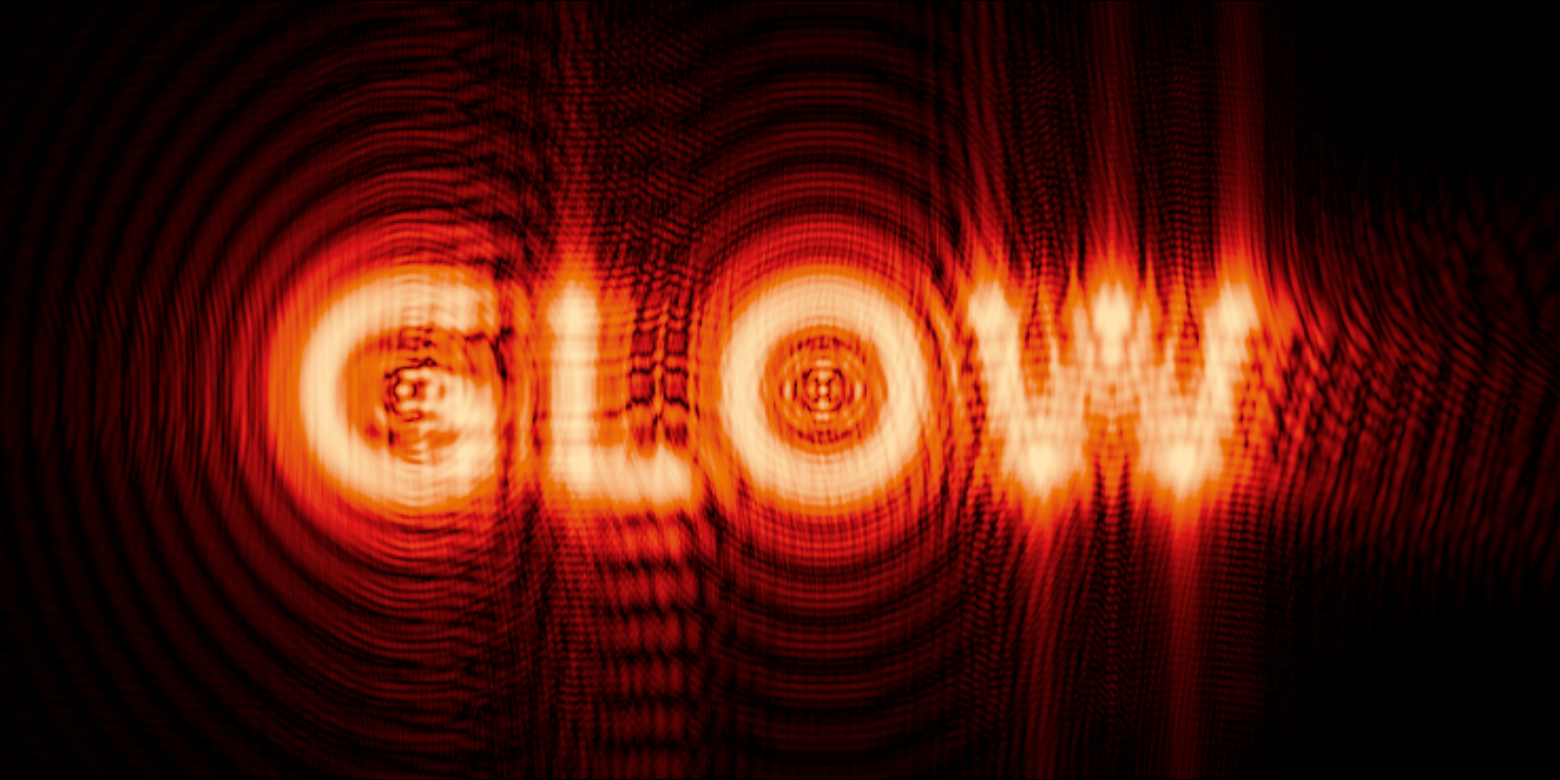
The project's name as a diffraction pattern
Simulated light passes through openings shaped like the letters GLOW and falls on a screen 100 mm behind them, resolving as the wavelength drops.
M. Zumalacárregui · CC BY 4.0
Animation (WebM) · Still frame (PNG) · 1560×780
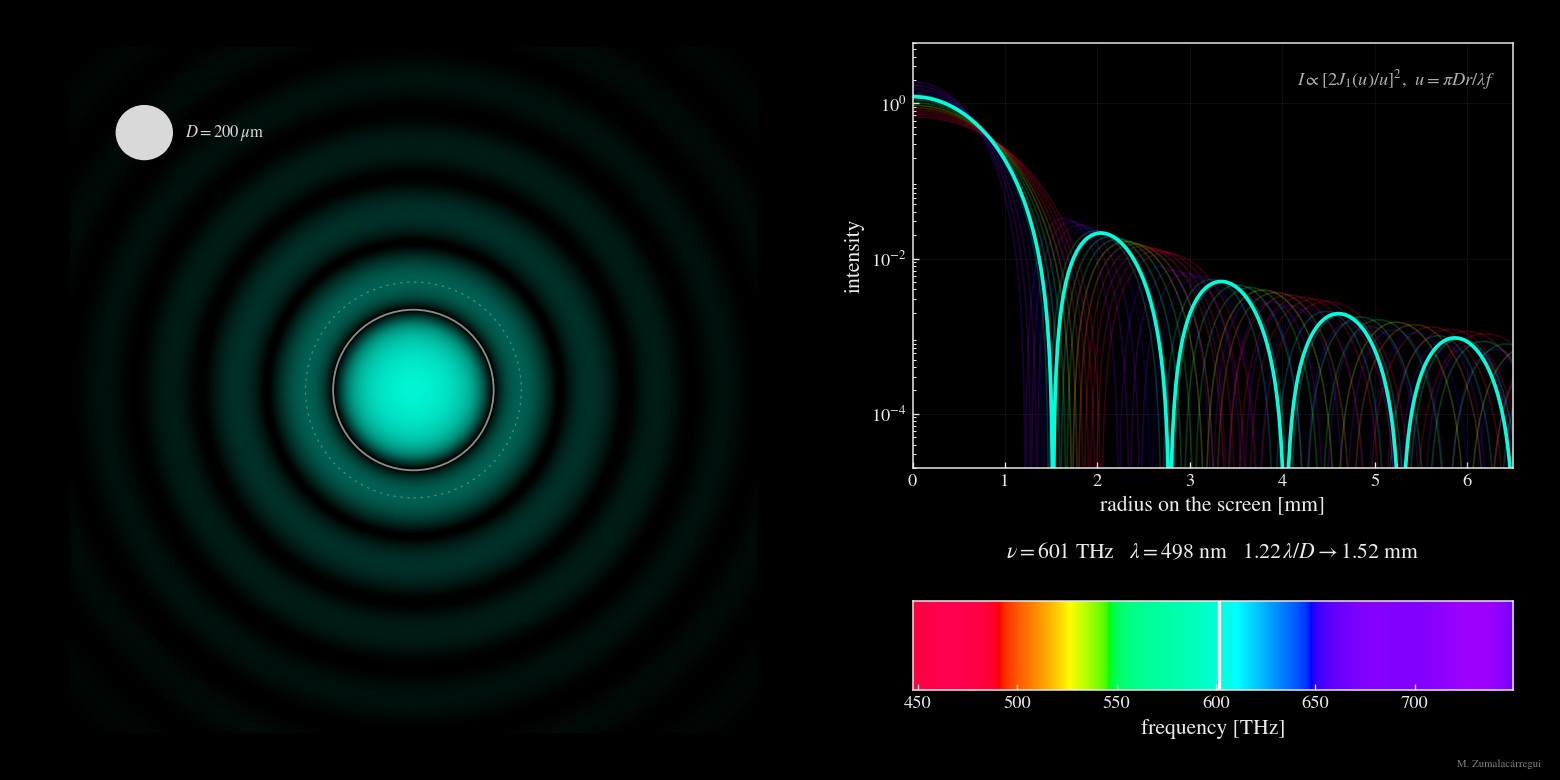
Diffraction through a circular hole
Visible light through a hole 200 micrometres across, one colour at a time: the rings contract as the wavelength falls.
M. Zumalacárregui · CC BY 4.0
Animation (WebM) · Still frame (PNG) · 1560×780
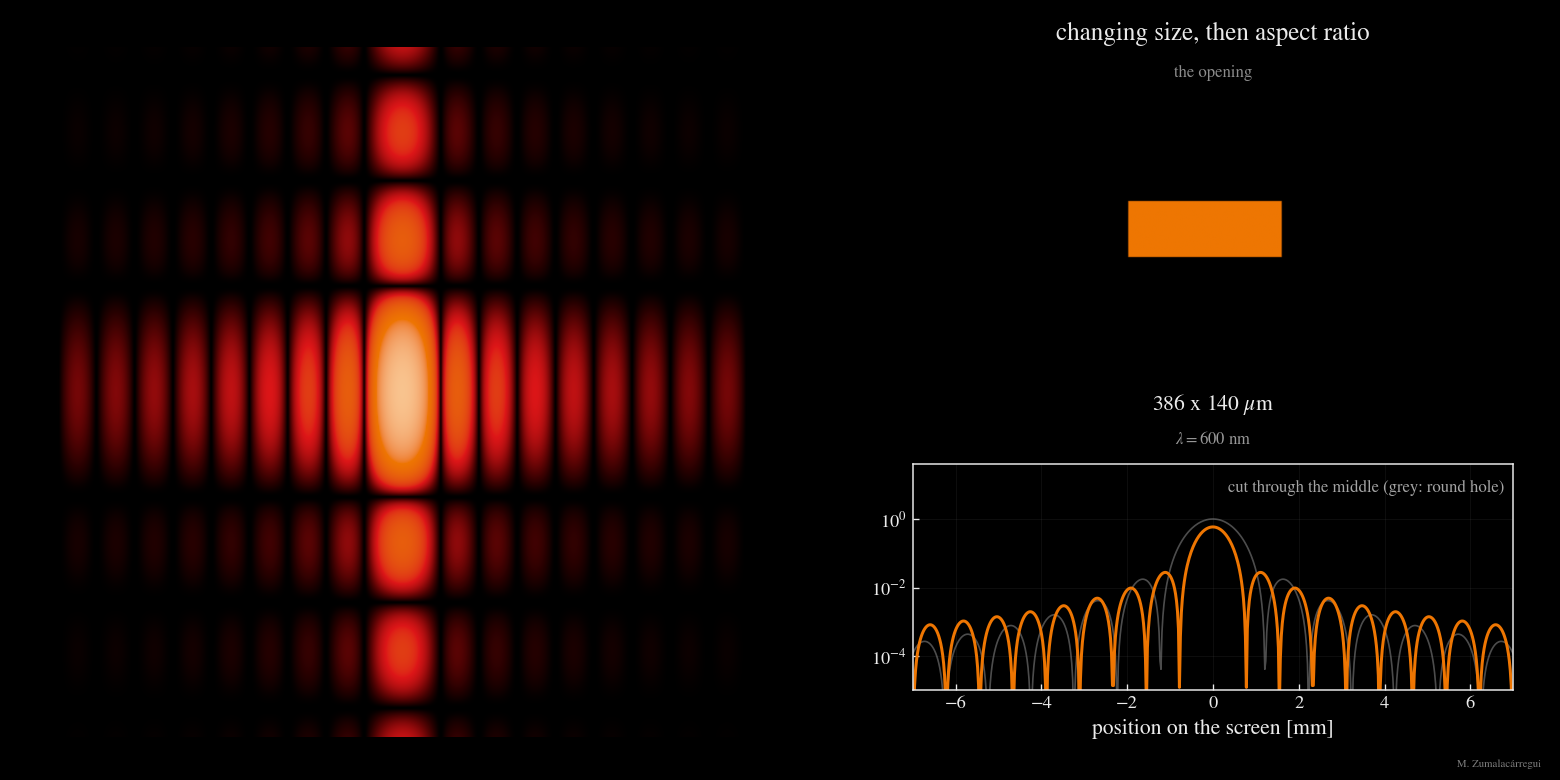
What an opening's size does to its pattern
The opening changes size and shape, and the pattern it casts changes with it, which is how a diffraction pattern carries information about the object that made it.
M. Zumalacárregui · CC BY 4.0
Animation (WebM) · Still frame (PNG) · 1560×780
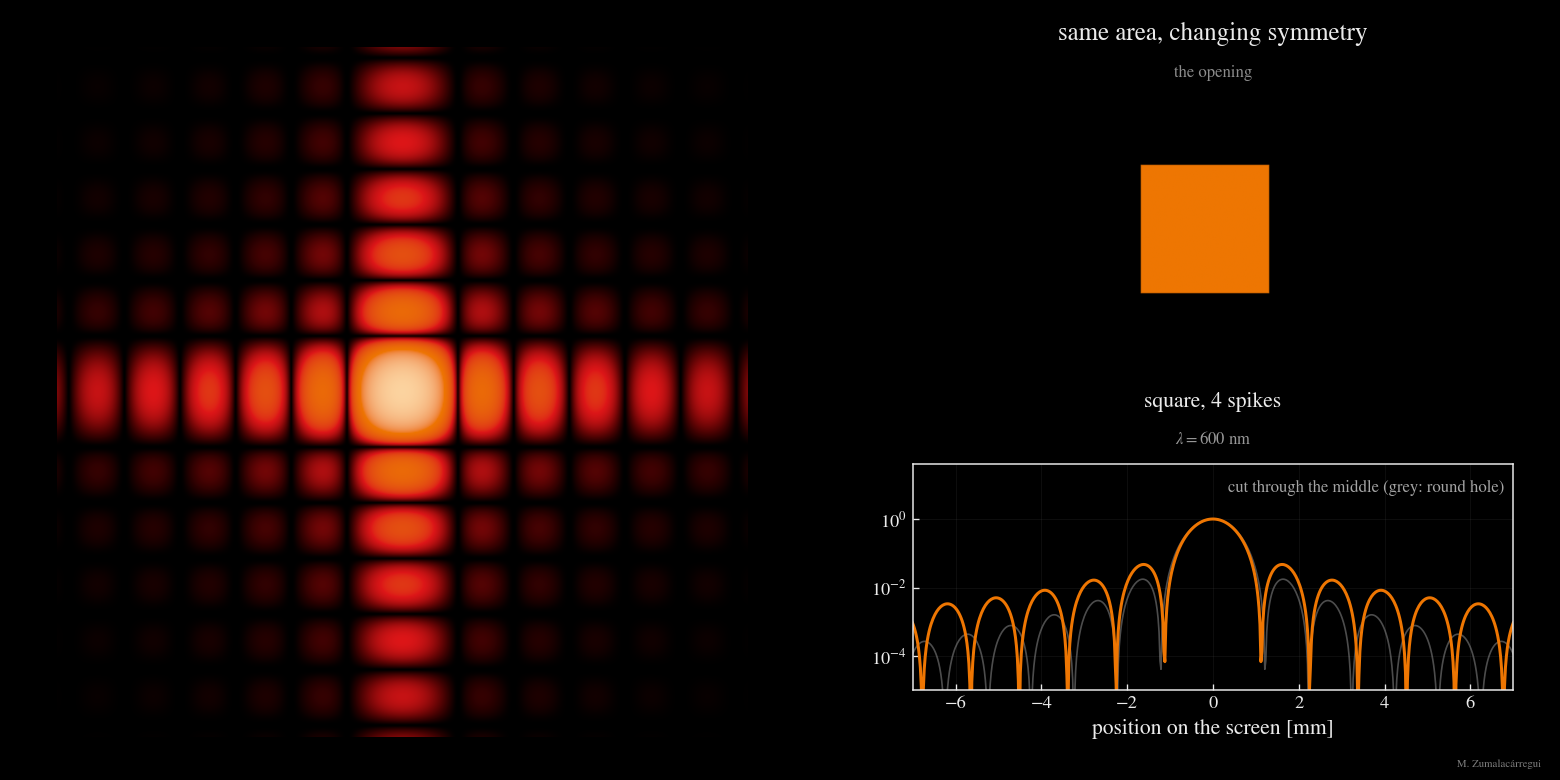
What an opening's shape does to its pattern
A circle, triangle, square, pentagon and hexagon of equal area, each leaving a different imprint on the wave.
M. Zumalacárregui · CC BY 4.0
Animation (WebM) · Still frame (PNG) · 1560×780
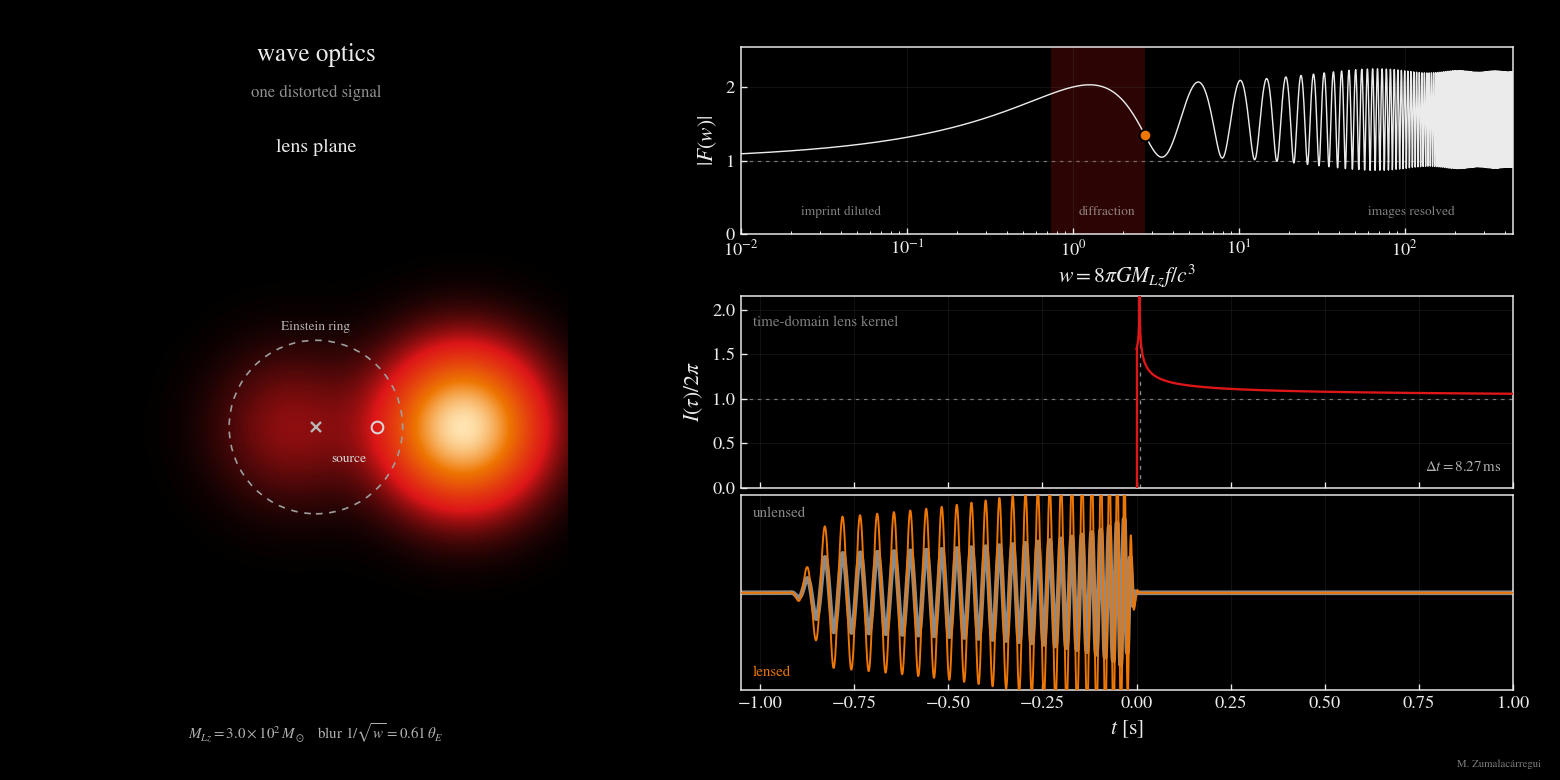
One lens across the whole frequency range
Nothing about the lens changes through the sweep: what changes is the ratio between its time-delay scale and the period of the wave.
M. Zumalacárregui · CC BY 4.0
Animation (WebM) · Still frame (PNG) · 1560×780
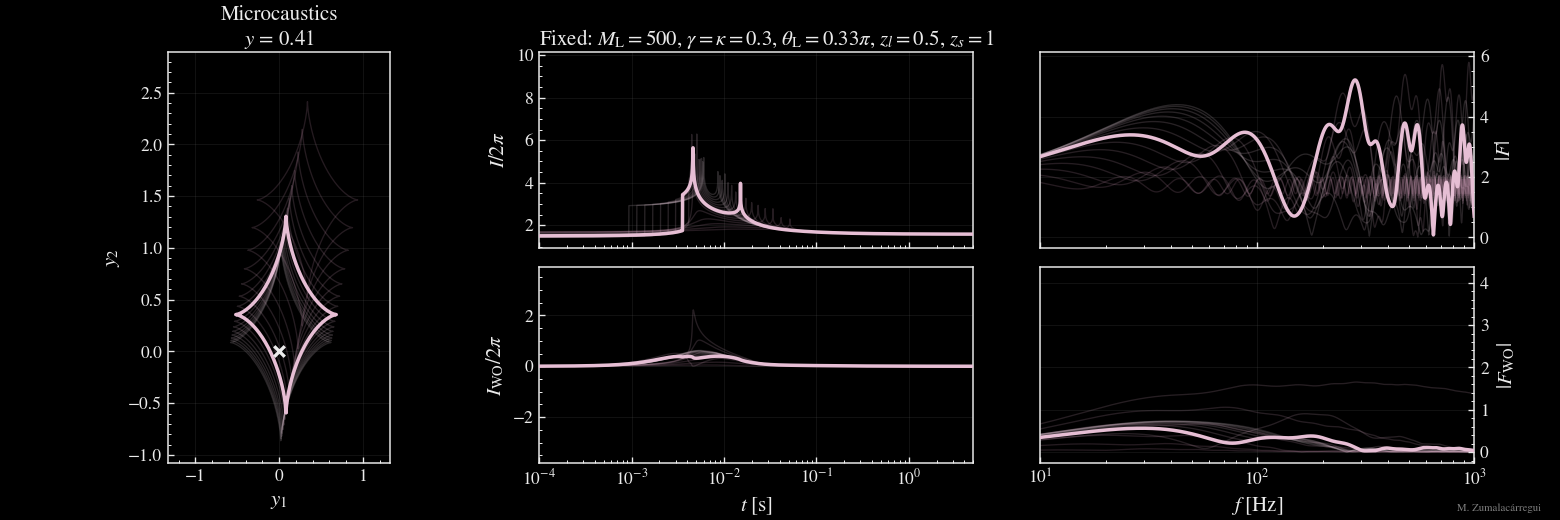
Diffraction appearing as the alignment tightens
The impact parameter falls from 2.0 to 0.1 Einstein radii, the source crosses a caustic, and the amplification factor acquires the oscillations that are the signature of diffraction.
M. Zumalacárregui · CC BY 4.0
Animation (WebM) · Still frame (PNG) · 1560×520
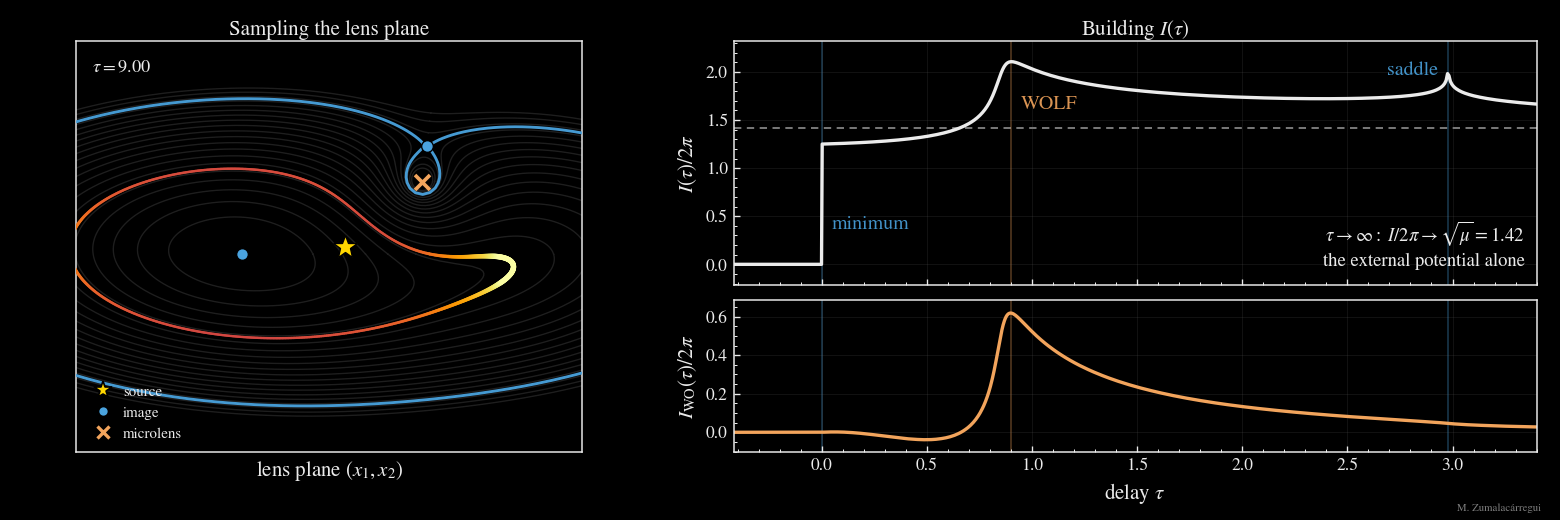
Building the arrival-time response of a lens
Isochrones of the Fermat potential sweep the lens plane for the best-fitting lens of GW231123, coloured by what each stretch contributes to the response.
M. Zumalacárregui · CC BY 4.0
Animation (WebM) · Still frame (PNG) · 1560×520
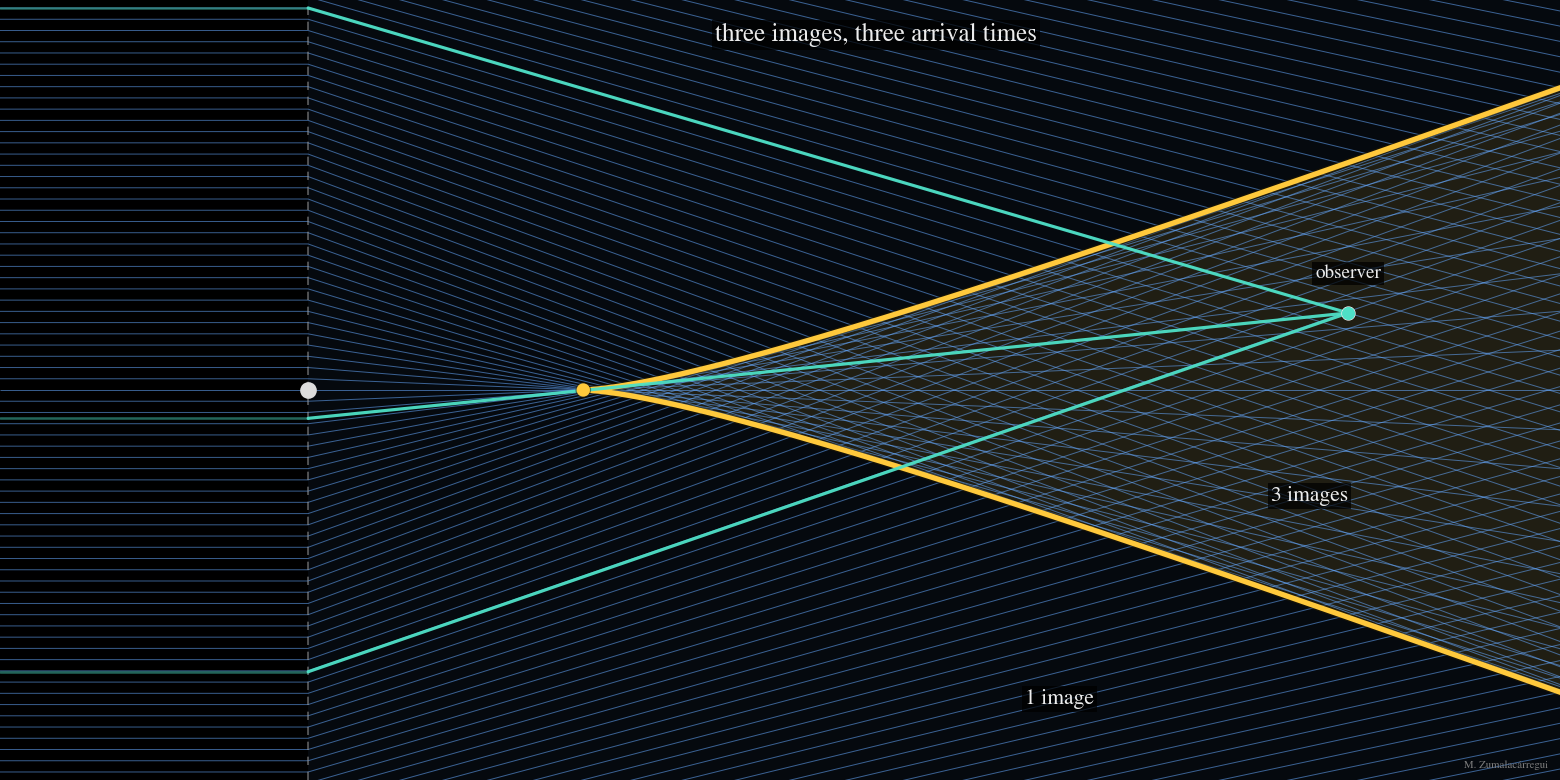
How multiple images form
A wavefront is bent by a lens and folds back on itself, and the cusp where it intersects itself traces out a caustic.
M. Zumalacárregui · CC BY 4.0
Animation (WebM) · Still frame (PNG) · 1560×780
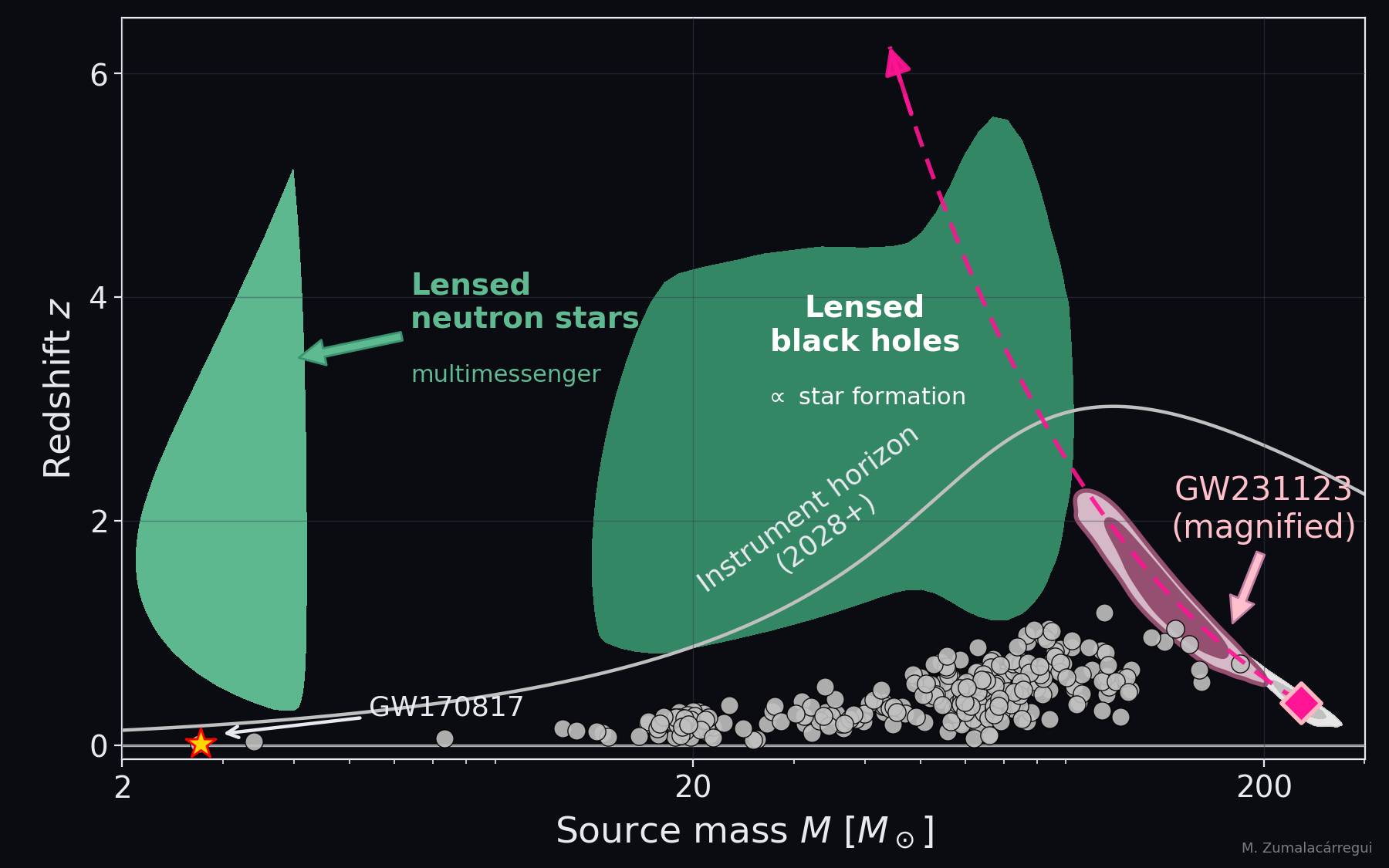
Lensed sources against the detectable population
Where magnified sources sit relative to what current detectors can see, with GW231123 marked both as it is usually analysed and as the lensed analysis infers it.
M. Zumalacárregui · CC BY 4.0
Figure (PNG) · 1800×1125
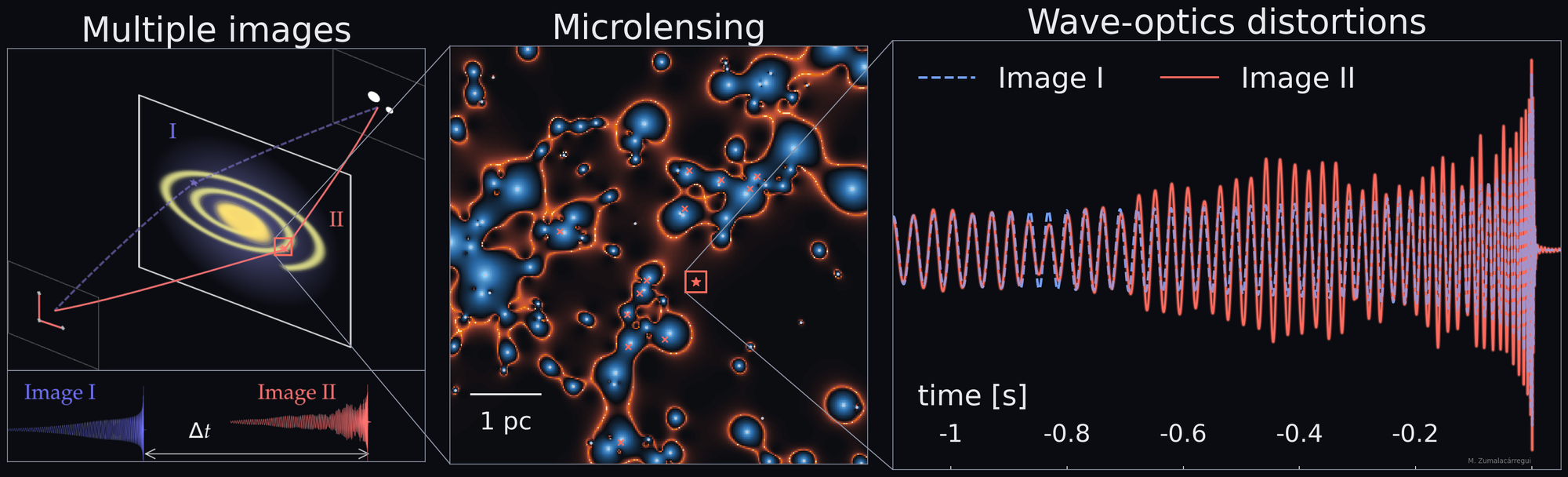
From a galaxy to a distorted waveform
A galaxy splits the source into macroimages, one of which lands on a field of stars whose critical curves distort the signal.
M. Zumalacárregui · CC BY 4.0
Figure (PNG) · 2000×608
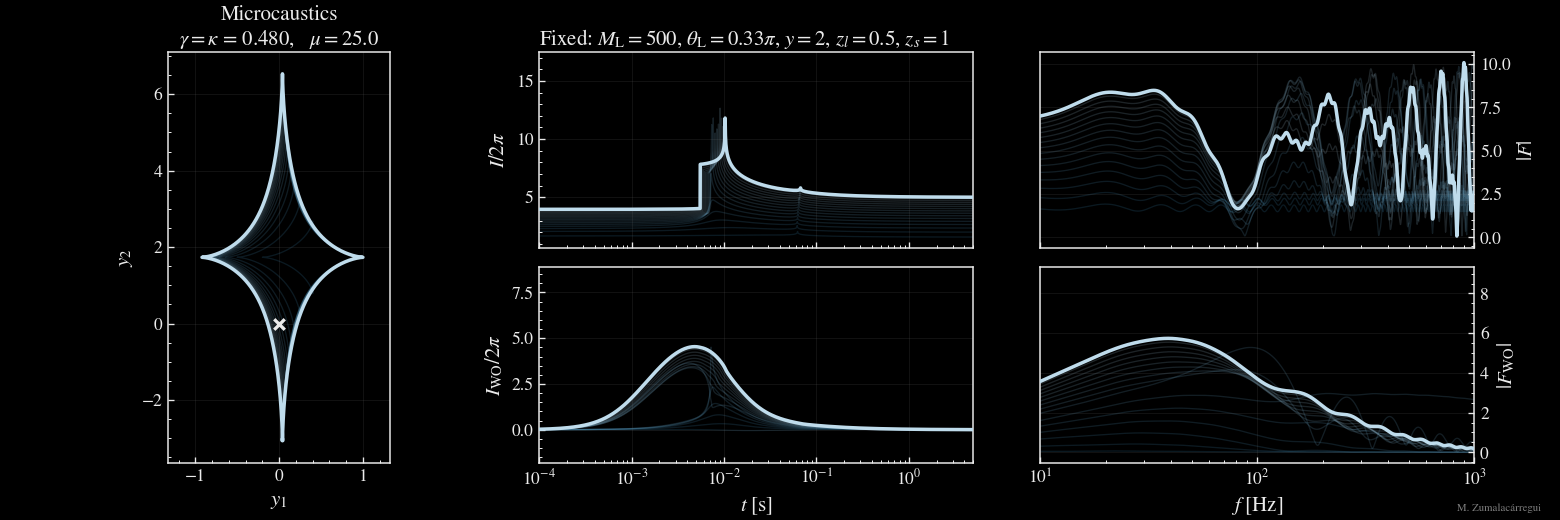
A point mass inside an external potential
The external potential grows, enlarging the caustic and strengthening the wave-optics distortions that come with it.
M. Zumalacárregui · CC BY 4.0
Animation (WebM) · Still frame (PNG) · 1560×520
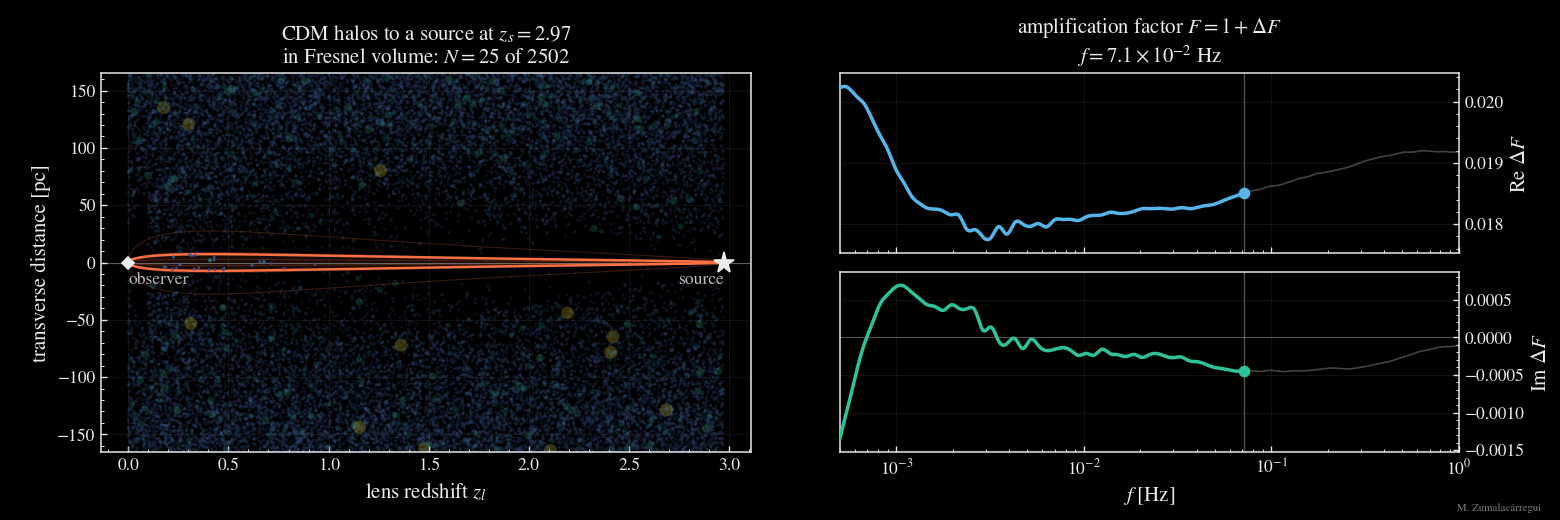
Stochastic diffraction and the dark timbre
A frequency sweep through one realization of 2502 cold-dark-matter halos along the line of sight to a source at redshift 3.
M. Zumalacárregui · CC BY 4.0
Animation (WebM) · Still frame (PNG) · 1560×520
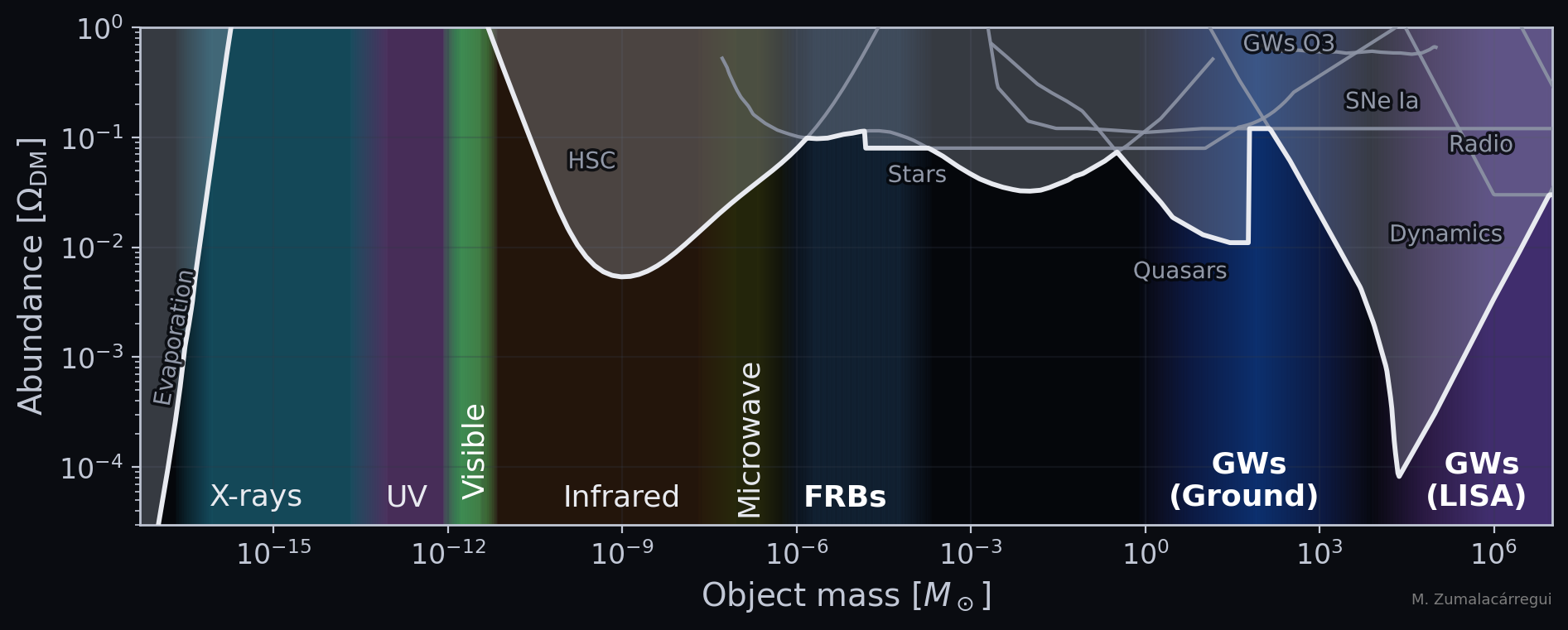
Limits on compact objects as dark matter
Existing bounds on the abundance of compact objects against their mass, with bands showing the masses each wave-optics probe reaches.
M. Zumalacárregui · CC BY 4.0
Figure (PNG) · 1893×761
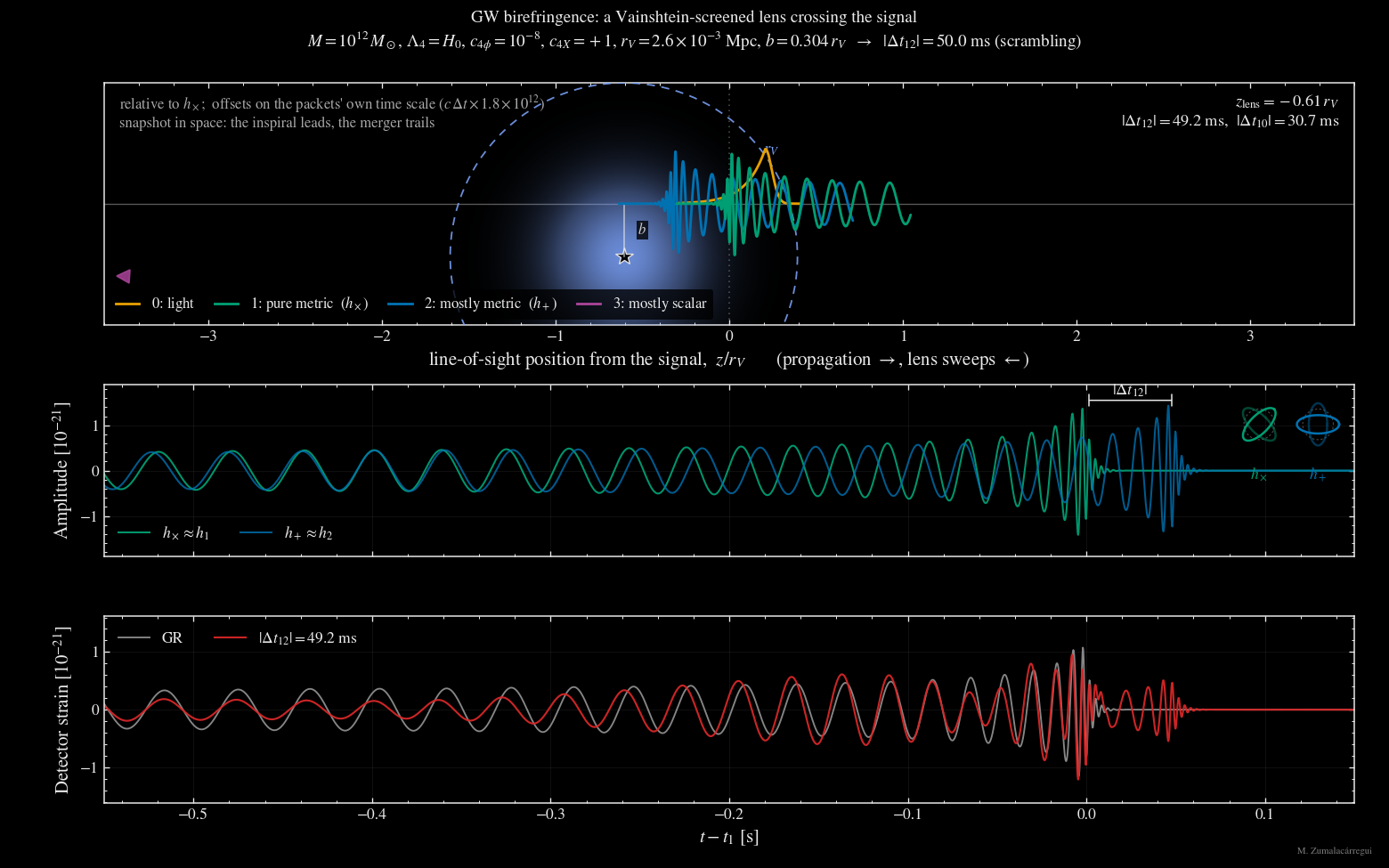
Gravitational-wave birefringence
A signal crossing a Vainshtein-screened lens, where the two polarizations travel differently and the waveform carries the difference.
M. Zumalacárregui · CC BY 4.0
Animation (WebM) · Still frame (PNG) · 1560×975
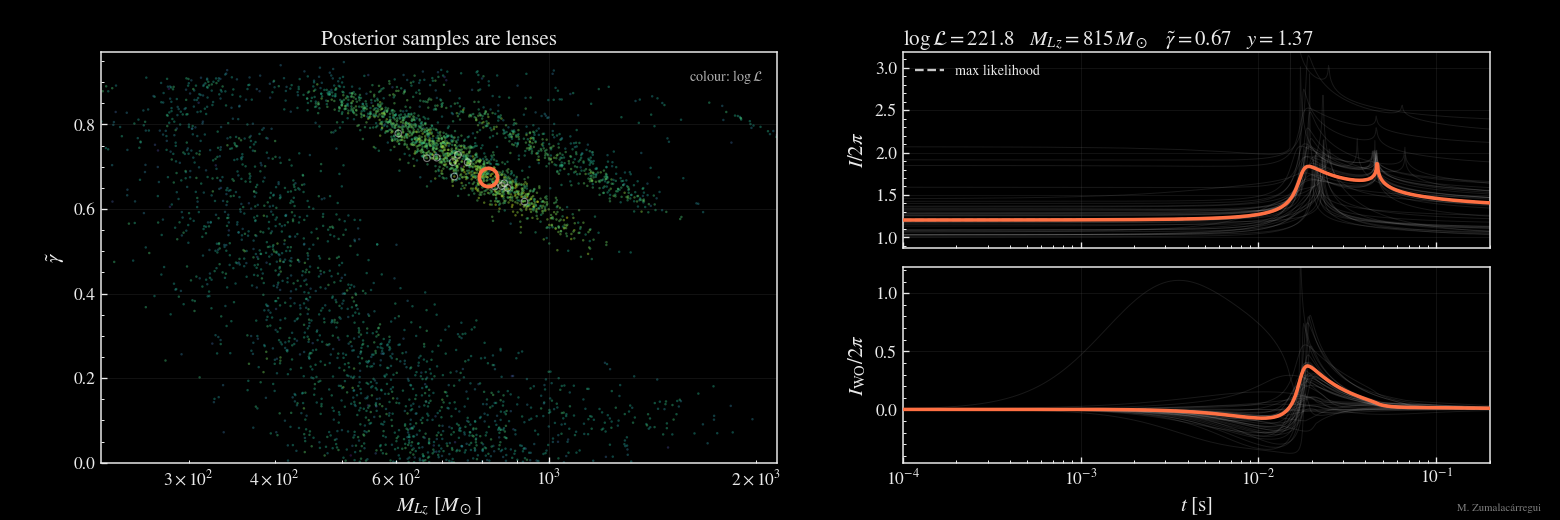
Parameter estimation in two dimensions
A sampler exploring a two-parameter lens model, with each point a candidate and the posterior emerging from the ones that survive.
M. Zumalacárregui · CC BY 4.0
Animation (WebM) · Still frame (PNG) · 1560×520
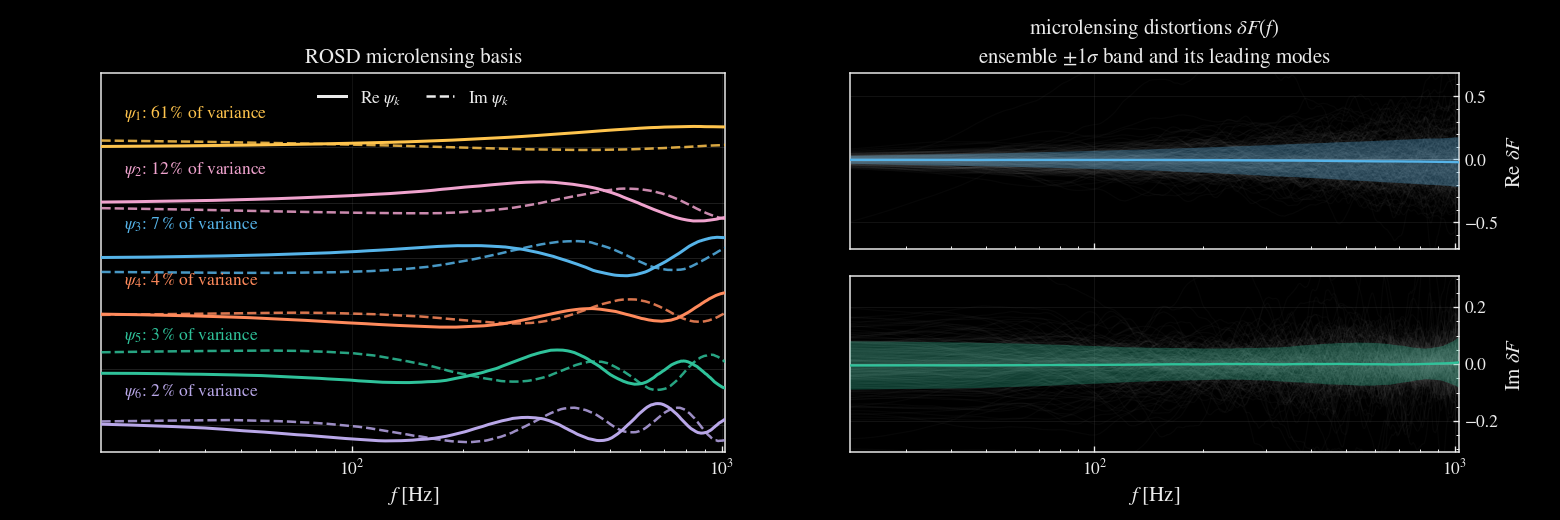
Ten thousand stellar fields, reduced to a basis
Distortion curves from ten thousand simulated fields collapse into a mean and a one-sigma band, and the first six modes carry most of the variance.
M. Zumalacárregui · CC BY 4.0
Animation (WebM) · Still frame (PNG) · 1560×520
No figure matches that search.
Logos
The two marks below identify the project and the code, and they are not covered by the licence above: use them to refer to GLOW or to GLoW, and do not alter them. Each comes in two versions, one for placing on a dark background and one for a light background, both with transparency. Ana Carvalho designed them.
GLOW, the project
The extended lock-up: the mark, the acronym and the full name.
For dark backgrounds (PNG) · For light backgrounds (PNG) · 6250×3064


GLoW, the code
The mark of the wave-optics code, different from the ERC project.
For dark backgrounds (PNG) · For light backgrounds (PNG) · 6250×3132
