
Science
Distant and strong-field sources
Gravitational magnification turns gravitational lenses into telescopes, enabling the observation of even the most distant sources. It can also reveal the association of a signal with a supermassive black hole.
Gravitational lenses as telescopes
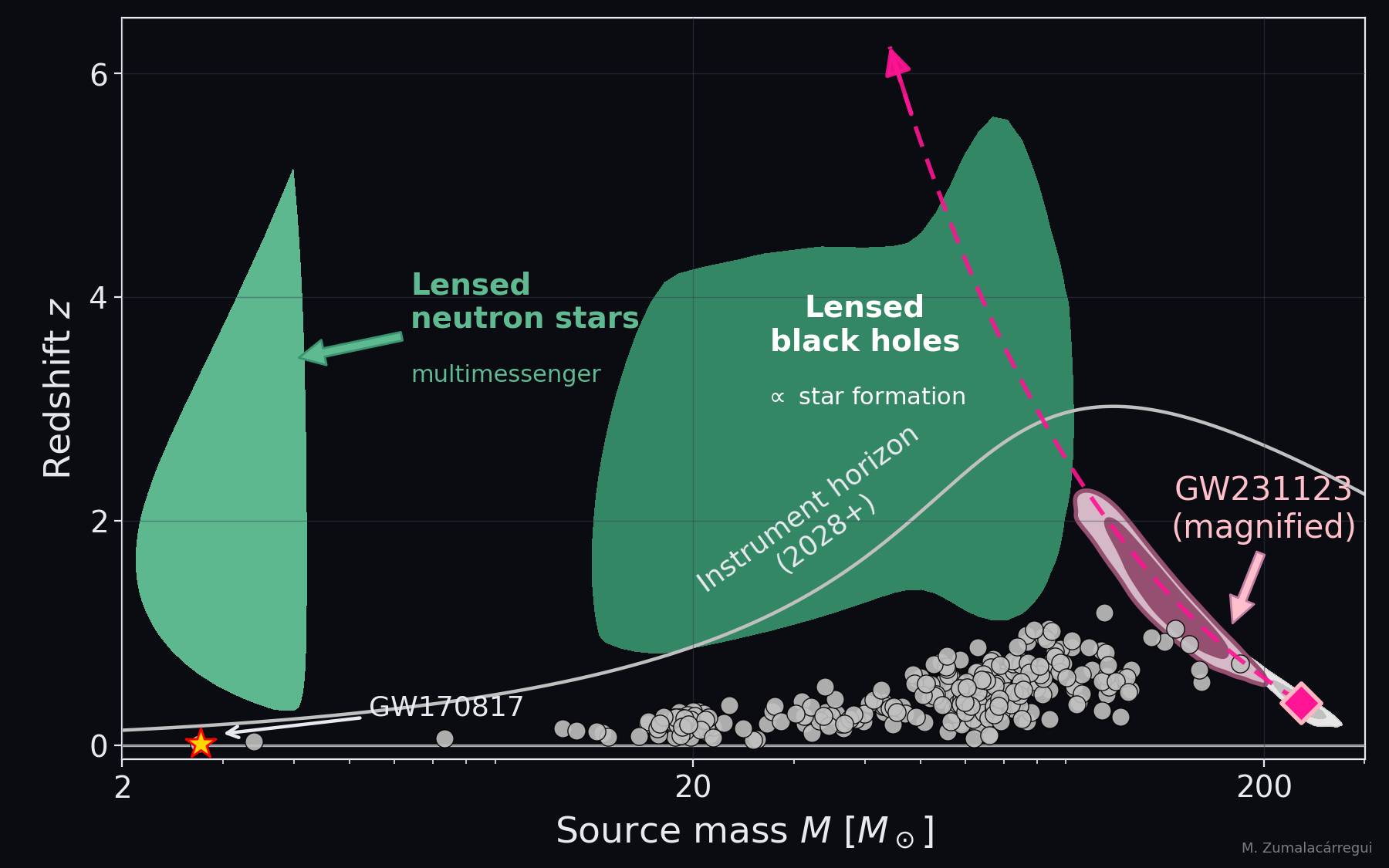
A detector's horizon is a measure of its sensitivity, indicating how far it can observe a certain type of source. A lens can enable observations beyond that horizon by making a signal louder: this was exquisitely leveraged by the Hubble Frontier Fields programme.
Gravitational-wave interferometers cannot point towards known lenses, but will over time register magnified sources, further into the Universe. The chances of observing lensed sources and their distribution can be understood as a tug of war between two competing effects: further sources need a close alignment with a lens (that is, a higher magnification to overcome the distance) but the number of potential lenses grows with the distance.[2]
Lensed gravitational waves will allow us to learn about how black holes and neutron stars formed in earlier cosmic epochs. The expected distribution of lensed events is shown in the figure above, assuming that binary mergers follow the star-formation history.[1] These predictions depend on the merger rate at high redshift, which is very poorly constrained. At a minimum, we will be able to constrain the merger rate at redshifts beyond the detector horizon. At best, we can detect sources well beyond the detector horizon, including remnants from the first stars and lensed neutron stars with electromagnetic counterparts.
Identifying lensed gravitational waves
Magnification of a gravitational wave cannot be identified on its own: it only makes the source appear closer. One possibility is when the lens forms multiple images. If two or more are recorded, they appear as separate events with different amplitudes (different magnifications) but the same underlying properties, such as mass ratio and spins. This has been a major pursuit by the gravitational-wave lensing community.[3]
Diffraction can be used to identify lensed sources. Like impurities in the lens of a telescope, stars and remnants within the lens galaxy produce distortions of the signal that give it away. A frequency-dependent distortion reveals the lensing and also says something about the properties of the lens. Compact objects in the lens galaxy produce microlensing, an effect routinely studied in lensed electromagnetic sources, but one that requires the inclusion of wave optics for coherent sources.
Diffraction and magnification have an instructive interplay, and GW231123 is where the project has worked it out. The event is the first compelling candidate for a magnified and diffracted black-hole merger: the diffraction imprint is what separates that reading from an ordinary unlensed source, and it is also what says where on the magnification track above the source actually sits. How firmly it does so depends on what is assumed about the source population before the data are seen, which remains an open question for this event.[4]
The role of diffraction is enhanced when microlensing and high magnification happen together. An external potential leading to high magnification increases the Einstein radii of stars and microlenses, making them much more effective at distorting gravitational waves. So the events that reach furthest are also the ones whose interpretation depends most on wave-optics microlens modeling. This is why the two topics are not separable in practice.
Towards multi-messenger lensing
A lensed binary neutron star would be the most valuable of these events and the hardest to find. The magnifications that bring one within reach are large, and large magnification is exactly the regime where microlensing by the lens galaxy's stars distorts the waveform most, so the signal that most deserves to be found is also the one least likely to match a template built for an undistorted source. Finding it needs both halves of this project at once: a theory of microlensing diffraction accurate enough to model the distortion, and inference fast enough to apply it in a low-latency search, while telescopes can still be pointed.
The reward is a measurement neither messenger makes alone. An electromagnetic counterpart fixes the arrival time of each image to milliseconds rather than to the days a light curve resolves, removing an important source of uncertainty in time-delay cosmography: the one that limits lensed quasars and supernovae. And because the same signal carries both a geometric-optics arrival time and a wave-optics distortion, the microlensing that usually limits such measurements is constrained by the data itself rather than marginalized over. The two regimes together give a long lever arm on the population of microlenses.
A detection is ambitious. But it is valuable enough that the Vera Rubin Observatory has an approved target-of-opportunity programme for exactly this case.[5]
Sources near supermassive black holes
The same reasoning about multiple images applies to a source close to the lens rather than far behind it. Binaries that form and merge in the disc of an active galactic nucleus can be carried close to the central supermassive black hole by migration traps, and the black hole then lenses the wave its own neighbourhood produced: some of these mergers should arrive as repeated images.[6]
That close in, the weak-field description stops being safe. The wave is generated and lensed within the same strongly curved region, and effects that vanish in the weak-field limit (birefringence between the two polarizations, and a dependence of the arrival time on frequency) become part of the signal.[7] Those are also the signatures that beyond-general-relativity theories of gravity and dark energy predict for propagation over cosmological distances. Multiple images around the black hole are what separate the two: an effect carried by one image and not another belongs to the strong-field region each took a different path through, while one shared by all of them belongs to the propagation, and so to the theory.
References
- , Discovering gravitationally lensed gravitational waves: predicted rates, candidate selection, and localization with the Vera Rubin Observatory Mon. Not. Roy. Astron. Soc. 520, 702 (2023)
- , Beyond the detector horizon: forecasting gravitational-wave strong lensing Astrophys. J. 921, 154 (2021)
- , GWTC-4.0: searches for gravitational-wave lensing signatures arXiv preprint (2025)
- , The diffraction-lensing interpretation of GW231123 with astrophysical priors arXiv preprint (2026)
- , Target-of-opportunity Observations of Gravitational-wave Events with Vera C. Rubin Observatory Astrophys. J. Suppl. 260, 18 (2022)
- , Astrophysical gravitational-wave echoes from galactic nuclei Mon. Not. Roy. Astron. Soc. 515, 3299 (2022)
- , Frequency- and polarization-dependent lensing of gravitational waves in strong gravitational fields Phys. Rev. D 109, 124045 (2024)
See also
- Work packages
- Microlensing searches