
Science
Microlensing
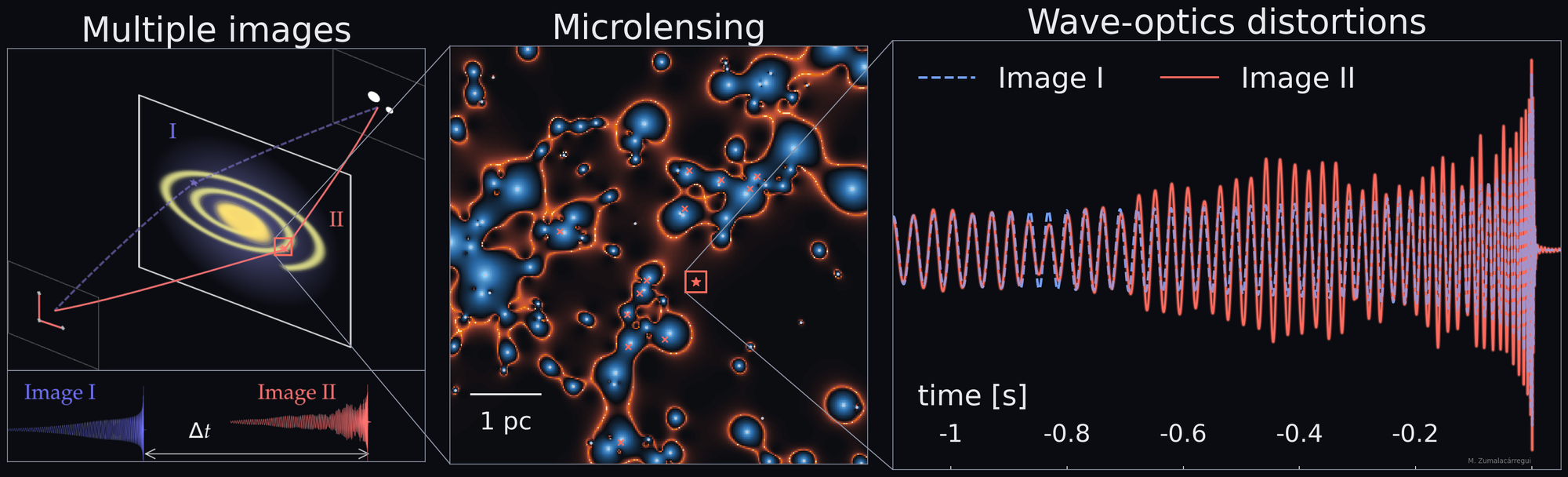
Real lenses are far more complex than an isolated, symmetric mass. Many stars and remnants in the lensing galaxy contribute to the total diffraction pattern, on top of the magnification by the galaxy's macroscopic potential. This "microlens" population needs to be understood and modeled.
Stochastic diffraction
When a galaxy acts as a telescope, small-scale objects become impurities on the lens. The image forms somewhere in that galaxy, and that place contains stars, stellar remnants and dark substructure: each one a lens contributing its own diffraction to the signal. At the frequencies ground-based detectors observe, the objects that matter most weigh tens to hundreds of solar masses,[1] but collective contributions from smaller-scale objects can also produce observable distortions.[2]
Stochasticity is a defining difficulty. There is no single microlensing waveform to search for, because the answer depends on a particular random arrangement of objects that nobody will ever measure. What can be predicted is the statistics: the distribution of distortions produced by a population of a given density and mass function.
This is also why microlensing is not only an astrophysical nuisance. The statistics depend on the population itself (its masses, its number density), which observations of wave-optics distortions may in turn constrain. Moreover, the same framework that describes stars in a lens galaxy describes a population of dark-matter objects along the line of sight: compact objects producing faint repetitions of a signal, or low-mass halos whose collective distortion carries the imprint of the whole population.[3] The lenses differ. The mathematics does not.
Multi-scale lensing
A microlens does not act alone either. It sits inside the potential of the host galaxy, which magnifies the image that the microlens is distorting. As the magnification produced by the galaxy rises, the same microlens imprints a far stronger signature. Highly magnified images (the ones most likely to be detected) are also the ones most strongly affected by microlensing.[4]
So the macroscopic lens model and the microscopic population have to be fitted together, connecting physics on vastly different scales. That makes inference harder, but also more informative: the distortion constrains the external potential, and hence the macroscopic magnification. The idea was demonstrated on real data in the analysis of GW231123, and it may allow high-redshift sources to be identified from their diffraction patterns.
Modeling microlensed waves
The route from stochastic physics to a usable search is compression. Simulating many realizations of a stellar field produces many amplification curves. Stochastic though they are, those curves are not arbitrary: they carry internal structure, and at finite detector sensitivity a small number of modes forms an effective basis for them. Fitting the coefficients of those modes turns an unpredictable lens into a handful of parameters, and the distribution of coefficients across realizations supplies a physically motivated prior for them. That is the reduced-order model the project's searches are built on.
References
- , Stellar-mass microlensing of gravitational waves Mon. Not. Roy. Astron. Soc. 503, 3326 (2021)
- , Wave effect of gravitational waves intersected with a microlens field II: An adaptive hierarchical tree algorithm and population study Sci. China Phys. Mech. Astron. 68, 219512 (2025)
- , Lens Stochastic Diffraction: A Signature of Compact Objects in Gravitational-Wave Data arXiv preprint (2024)
- , Gravitational lensing of gravitational waves: effect of microlens population in lensing galaxies (2021)
See also
- Work packages
- Microlensing diffraction · Microlensing searches · Dark-matter searches